
The fastest muscle soreness relief comes from massage, light movement, sleep, and food. Post-exercise soreness peaks one to three days after a hard session and clears on its own within about five days. Nothing makes it vanish overnight, but the right steps genuinely take the edge off while your muscles repair.
If you are reading this at the top of a staircase you are a little afraid to walk down, you are in the right place. That feeling is normal, it is temporary, and it is not a sign you did something wrong. In our experience at TruFit, the members who get hit hardest by soreness are usually the ones who did something right: they showed up, they tried something new, and their body noticed.
Most advice on how to relieve muscle soreness is a list of everything anyone has ever tried, presented as though each item works equally well. They do not. Here is what actually helps, ranked by how strong the evidence is, plus two popular fixes that the research does not support.
Why are my muscles so sore after a workout?
Because you made tiny tears in your muscle fibers, and your body is repairing them.
According to the Cleveland Clinic, your muscles are made of thousands of small fibers, and exercise “can sometimes cause tiny tears in those fibers.” That sounds alarming. It is actually the mechanism by which you get stronger. Your muscles grow when your body repairs those tears.
The clinical name is delayed onset muscle soreness, usually shortened to DOMS. The delay is the defining feature. You will not feel it during your workout. It builds over several hours and shows up one to three days later, in the exact muscles you trained.
One movement type causes far more of it than the rest: eccentric exercise, meaning any time a muscle lengthens while under tension. The lowering half of a bicep curl. The descent of a pull-up. Walking downhill. Landing from a jump. Lunges. This is why a Romanian deadlift session leaves your hamstrings talking to you two days later, and why a first Murph attempt has people walking sideways down stairs on Wednesday.
One thing that is not causing it: lactic acid. That myth has outlived its evidence by decades. Lactate clears from your blood within about an hour of finishing. It is long gone by the time soreness arrives.
How long does muscle soreness last?
Two to five days for most people.
The Cleveland Clinic puts it plainly: DOMS “usually lasts a few days after the exercise that started it” and “rarely lasts more than five days.” It should also fade a little each day. That gradual improvement is the signal that things are working normally.
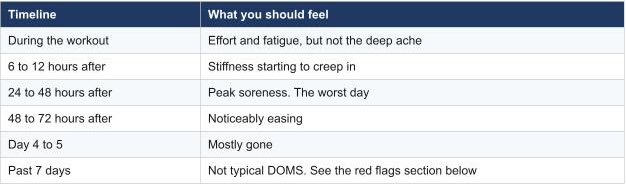
If soreness lasts a week or more, the Cleveland Clinic notes you might have an injury such as a muscle strain rather than ordinary DOMS.
Is soreness a sign of muscle growth?
Soreness is a sign of unfamiliar stress, not a scorecard for progress.
This is the single most useful thing to understand about muscle soreness relief, because it changes what you chase. Soreness tracks novelty. A new exercise, a heavier load, a longer session, or a return after time off all produce it. As you adapt to a movement, you get less sore from it while continuing to get stronger.
That means an experienced lifter who is no longer sore after leg day is not failing. They are adapted. And a beginner who is extremely sore has not earned a better workout than someone who is not. When coaches on our floor hear “I want to be sore tomorrow,” we usually redirect the conversation toward whether the weight on the bar is going up over a month, because that is the number that predicts results.
Chasing soreness has a real cost. You end up constantly changing your program to stay sore, which is the surest way to never progress at anything. A stable structure, like a 4-day workout split or the split that actually fits your goals, beats novelty for its own sake.
9 muscle soreness relief methods that actually work
These are ordered by the strength of the evidence behind them, not by popularity. Sore muscles after a workout respond to some of these far better than others, and the gap between the top of this list and the bottom is much wider than most advice admits.
The most useful data here comes from a systematic review and meta-analysis published in Frontiers in Physiology in 2018. It pooled 99 studies, with 80 studies and 1,188 participants in the soreness analysis alone, and compared recovery methods head to head. The effect sizes below come from that paper.
1. Massage
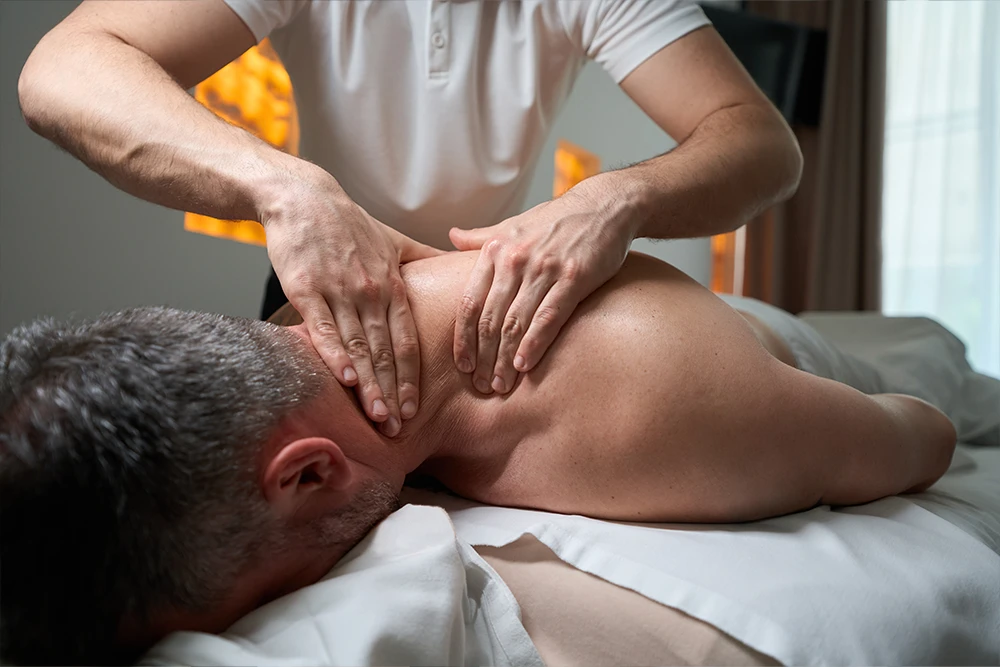
Massage produced the largest effect on soreness of anything tested, with an effect size of negative 2.26. Nothing else in the analysis came close. It also produced the biggest reduction in perceived fatigue.
You do not need a sports therapist on retainer. At TruFit, the Relax and Recovery area includes hydromassage, Polar Wave beds, and red light therapy, which is the practical version of this for most members: ten to fifteen minutes on your way out of the building.
2. Light movement
Active recovery came second, at negative 0.94. This is the one that feels most wrong and works best.
Your instinct when you are sore is to keep still. Moving gently does more. A walk, an easy bike, a slow swim, or twenty minutes of low-intensity cardio increases blood flow to the tissue that is repairing itself without adding new damage.
The 12-3-30 treadmill walk is a good template, though on a sore day drop the incline to something modest and treat it as circulation rather than a workout. Our guide on cardio before or after weights makes the same point about cool-downs: ten to fifteen minutes of steady, moderate cardio after lifting leaves you feeling loose rather than stiff.
3. Sleep
Sleep is where tissue repair actually happens. It is also the recovery tool nobody sells, which may be why it gets the least attention.
There is no supplement, roller, or cold plunge that compensates for five hours a night. If you are sore and short on sleep, fix the sleep first.
4. Water
Dehydrated muscle is more prone to fatigue and cramping, and stiffness feels worse when you are down on fluid. This is the cheapest item on the list, and the one most people skip on the day after a hard session, because they were thinking about hydration during the workout and stopped afterward.
Our guide to hydration when lifting covers how much and when. On a sore day, keep drinking past the point where you feel thirsty.
5. Protein and real food
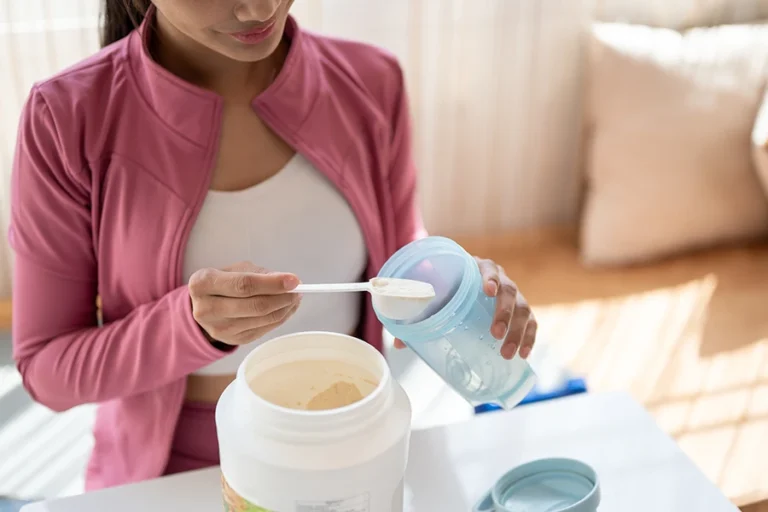
Repairing muscle requires the raw material to repair it with. Spread protein across the day rather than loading it all into one meal, and do not train hard in a large calorie deficit and then wonder why you stay sore for four days.
If you use creatine, our guide on creatine timing explains why the daily habit matters far more than the hour you take it.
6. Foam rolling
Foam rolling helps, and it helps less than the internet claims. Both halves of that sentence matter.
A meta-analysis by Wiewelhove and colleagues in Frontiers in Physiology (2019) looked at seven studies of post-exercise rolling and found a 6.0% improvement in muscle pain perception, an effect size of 0.47. The authors described foam rolling’s overall effects on performance and recovery as “rather minor and partly negligible, but can be relevant in some cases,” and concluded the evidence better supports rolling as a warm-up tool than a recovery strategy.
So roll if it feels good, because feeling better is a legitimate goal. Just know you are managing the sensation rather than accelerating repair. Sixty to ninety seconds per muscle group, slow, and back off anything that makes you hold your breath.
7. Heat
Heat increases blood flow to the area and loosens the stiffness that makes sore muscles feel worse than they are. A dry heat sauna, a warm shower, or a heating pad all qualify. This is the option to reach for when the dominant complaint is stiffness rather than sharp pain.
8. Cold
Cold water immersion showed a smaller effect on soreness than massage or light movement, at negative 0.47, but it was still a real one, and it was among the more effective options for inflammatory markers. Cold reduces pain and inflammation, so it fits better in the first several hours after a session.
One caveat worth knowing: if your goal is building muscle, routinely icing straight after every lifting session may blunt some of the adaptation you trained for. Save it for when soreness is genuinely interfering with your day.
9. Compression
Compression garments came in at negative 0.92 for soreness, which puts them roughly level with light movement and well ahead of cold. Compression socks or sleeves worn for a few hours after a hard session are a low-effort, low-cost option that quietly outperforms most of what gets marketed harder.
What does not work for muscle soreness relief?
Two things get recommended constantly and do not hold up.
Static stretching. In the 2018 meta-analysis, stretching was the only intervention that failed to help soreness at all. The effect size was positive 0.15 and not statistically significant, meaning the data could not distinguish it from doing nothing. Stretching is worth doing for mobility, and it feels pleasant, so keep it if you like it. Just do not expect it to shorten your soreness. Our hamstring exercises guide covers mobility work in the context where it does pay off.
Flushing out lactic acid. You cannot flush out something that is not there. Lactate clears within roughly an hour of finishing exercise, long before DOMS begins. Any method sold on this explanation is being sold on a mechanism that does not exist. Some of those methods, like light movement, work anyway. They just work for a different reason.
Should I work out with sore muscles?
Usually yes, with adjustments. The Cleveland Clinic’s guidance is that moving and using sore muscles in your everyday routine should be fine, but to avoid using those specific muscles for intense exercise while they are sore.
Three practical rules from our floor:
- Train something else. Sore legs do not stop you from doing an upper body session. This is one of the underrated advantages of a structured split like push pull legs, where leg day gets a natural recovery window built in.
- Cut the load, keep the movement. If you want to train the sore muscle anyway, drop to roughly half your usual weight and stay well away from failure. Movement at low load often reduces soreness during the session.
- Stop if form breaks or pain is sharp. A dull, spread-out ache across a whole muscle is DOMS. Sharp, specific, localized pain is not, and pushing through it is how a sore week becomes an injured month.
The Cleveland Clinic also notes that training through soreness without letting your body recover can shift stress onto your joints as your form quietly degrades, raising the risk of strains and sprains.
How do I prevent muscle soreness next time?
You cannot prevent it entirely, and you should not want to, since some soreness is the price of asking your body to do something new. You can make it far less brutal, and prevention is cheaper than muscle soreness relief after the fact.
- Add load gradually. Most severe soreness comes from a jump that was too big. Small weekly increases produce the same result with a fraction of the misery.
- Warm up properly. Five to ten minutes of light cardio plus a few build-up sets of the first movement. This is where foam rolling has the better evidence, so roll here rather than after.
- Ease into anything new. First session of a new program, new class, or new exercise, do fewer sets than you think you need. You can always add next week.
- Cool down instead of stopping cold. Ten minutes of easy movement after your last set.
- Repeat workouts before replacing them. The second time you do a session, you will be dramatically less sore. This adaptation is called the repeated bout effect, and it is free.
If you are just starting out, or restarting, our guides on kickstarting a fitness routine and sticking with your goals are built around exactly this problem. The first two weeks are where soreness makes people quit, and a slower ramp is what prevents it.
When soreness means something is wrong
Almost all post-workout soreness is harmless. A small amount is not, and it is worth knowing the difference.
See a healthcare provider if:
- Pain is severe rather than achy
- Soreness lasts longer than a week, which can indicate a strain instead of DOMS
- You get significant soreness after most of your workouts, not just hard or new ones
- The pain is sharp and localized to one specific spot
- You have swelling in a limb that keeps getting worse
Go to an emergency room if you have symptoms of compartment syndrome or rhabdomyolysis. The Cleveland Clinic classifies both as medical emergencies. They are rare, and they are associated with severely overworking muscles, often after an extreme session by someone unaccustomed to it. Warning signs include disproportionately severe pain and swelling, dramatic weakness, and dark or cola-colored urine.
We are coaches, not clinicians. If something feels wrong rather than just sore, get it looked at by someone qualified to look at it.
Come use the recovery floor
You do not have to figure this out alone, and you do not have to buy a closet full of recovery gadgets. Massage is the most evidence-backed option on this list, and TruFit’s Relax and Recovery area has hydromassage, Polar Wave beds, red light therapy, and a dry heat sauna available to members as part of the membership.
If soreness keeps knocking you off track, that is usually a programming problem rather than a toughness problem. A TruFit personal trainer can build a progression that gets you stronger without wrecking you for three days at a time.
New here? Take a risk-free 3-day guest pass, try the recovery area, and find the club nearest you. You can compare membership plans whenever you are ready.
Frequently Asked Questions
How do you get rid of muscle soreness quickly?
Massage has the strongest evidence, followed by twenty minutes of light movement. Add sleep, water, and protein, and use heat for stiffness. There is no method of muscle soreness relief that removes it overnight, because the underlying repair takes a few days regardless of what you do.
How long does DOMS last?
Typically two to five days, peaking around 24 to 48 hours after the session. The Cleveland Clinic notes it rarely lasts more than five days. Soreness past a week suggests a strain rather than ordinary DOMS. There is no DOMS treatment that shortens the repair itself, so the goal is comfort while it runs its course.
Does stretching help sore muscles?
Not for soreness. The 2018 meta-analysis in Frontiers in Physiology found stretching had no statistically significant effect on delayed onset muscle soreness. It remains useful for mobility, just not as muscle soreness relief.
Does soreness mean muscle growth?
No. Soreness reflects how unfamiliar the work was, not how effective it was. Trained lifters get sore less often while continuing to gain strength. Track whether your working weights are increasing over weeks, not how sore you feel the next morning.
What is the best drink for sore muscles?
Water, in more volume than you think, plus something containing protein if you have not eaten. There is no beverage with a specific effect on DOMS, and any product marketed for flushing out lactic acid is selling a mechanism that does not exist.
Should I take ibuprofen for sore muscles?
Over-the-counter pain relievers can reduce the discomfort, and some evidence suggests routinely using anti-inflammatories around training may interfere with the adaptations you are training for. Occasional use for genuinely disruptive soreness is a different situation from taking them after every session. Ask a pharmacist or your doctor about what is appropriate for you.
Is it normal to be this sore as a beginner?
Yes, and it will not be like this for long. The first few sessions of any new routine produce the most soreness you will experience. By the third or fourth repeat of the same workout, most people notice a dramatic drop.