


A full body workout trains every major muscle group (legs, hips, back, chest, shoulders, arms, and core) in one session. Run it three times a week on non-consecutive days and every muscle group gets trained three times weekly. That is more frequency than most gym splits deliver in the same number of hours.
The plan below is the one our trainers reach for most often, and not because it is fancy. It works because it survives a real week. Miss a Wednesday, and you have still trained your whole body twice. Miss a Wednesday on a five-day split, and your back or your legs just got skipped entirely.
What is a full body workout?
A full body workout is a single training session that hits all seven major muscle groups the federal physical activity guidelines list by name: legs, hips, back, abdomen, chest, shoulders, and arms. Instead of dedicating Monday to chest and Tuesday to back, you cover everything each time you walk in.
Most sessions are built from five or six compound movements, meaning exercises that move more than one joint and recruit large amounts of muscle at once. A squat is a compound movement. A bicep curl is not. That distinction is what makes a whole session possible in under an hour.
The Centers for Disease Control and Prevention recommends adults do muscle-strengthening activities “on 2 or more days a week that work all major muscle groups.” A three-day full body routine clears that bar comfortably, which is one reason it is such a defensible starting structure for anyone who is not already deep into a specialized program.
Is a full body workout better than a split?
Neither one wins outright. What decides it is how many days a week you will actually show up.
Here is the honest version of the research. Schoenfeld, Grgic, and Krieger published a systematic review and meta-analysis in the Journal of Sports Sciences asking how many times per week a muscle should be trained. Their conclusion, when total weekly sets were held equal between groups: training frequency “does not significantly or meaningfully impact muscle hypertrophy when volume is equated.” Lifters can pick a weekly frequency based on personal preference.
Read that carefully, because it cuts against a lot of gym folklore. Total weekly volume is the thing that drives growth. Frequency is the delivery vehicle. A full-body workout three times a week and a push pull legs split run six times a week can produce very similar results if the weekly set totals match.
So the question becomes practical rather than physiological:
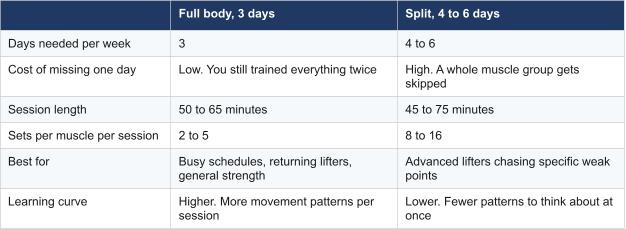
In our experience at TruFit, the people who stall out are almost never the people who chose the wrong split. They are the people who chose a split that needed five days from a life that had three. If you have four or more reliable days, our 4 day workout split gives you more room for accessory work. If you have three, stay here.
The 3-day full body workout plan
Run this on non-consecutive days. Monday, Wednesday, Friday is the classic arrangement. Tuesday, Thursday, Saturday works identically. What matters is the rest day between sessions, because you are training the same muscles again in 48 hours and they need it.
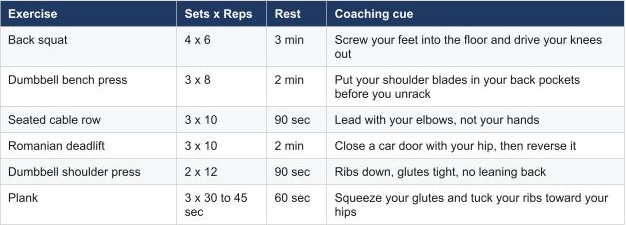
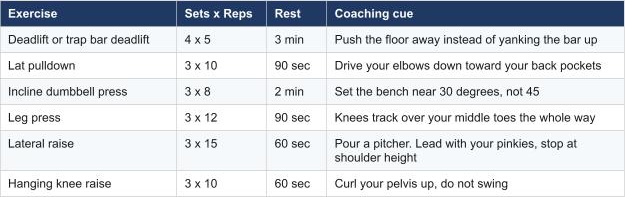
Each day has a different emphasis. Day 1 leans on the squat, Day 2 on the hinge, Day 3 on pressing and pulling. Everything still gets trained every day. The emphasis just rotates so no single pattern gets hammered three times a week at maximum effort.
Day 1: Squat emphasis
Day 2: Hinge emphasis
Day 3: Press and pull emphasis
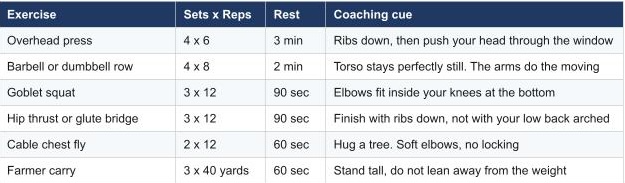
Eighteen sets per session. Fifty to sixty-five minutes with the prescribed rest. If that math surprises you, it is because the rest periods are longer than the ones most people take, and there is a reason for that.
How to do the five core lifts correctly
Five movements carry this program. Get these right, and the rest is detail work.
How to squat correctly
- Set the bar on your upper back, not your neck. Pull your elbows down to lock it in place.
- Take a stance a little wider than your hips, toes turned out roughly 15 to 30 degrees.
- Screw your feet into the floor. This is the cue we use more than any other. It means actively rotating your feet outward against the ground without letting them move, which locks your arches and stops your knees from collapsing inward.
- Take a breath into your belly and brace as if someone is about to poke you in the stomach.
- Sit down and back at the same time. Knees travel forward over your toes. That is allowed.
- Go as deep as you can with a flat lower back, then drive your knees out on the way up.
How to hip hinge for the Romanian deadlift
- Hold the bar or dumbbells at your thighs, knees softly bent and staying that way.
- Push your hips straight back like you are closing a car door with your hip.
- Let the weight slide down your legs, staying in contact with them.
- Stop when you feel a strong stretch in your hamstrings. For most people that is mid-shin, not the floor.
- Squeeze your glutes and drive your hips forward to stand up.
Most people cannot feel this pattern the first time. That is normal. Our hamstring exercises guide has regressions that teach it faster, and the glute exercises breakdown covers why the hinge matters more than any squat variation for the back of your body.
How to bench press without wrecking your shoulders
- Set your eyes under the bar. Grip just outside shoulder-width.
- Put your shoulder blades in your back pockets. Pull them down and together, then keep them there.
- Unrack, and take the bar to the bottom of your sternum, not your collarbones.
- Tuck your elbows to roughly 45 degrees from your torso. Flared elbows are where shoulders get hurt.
- Press back up and slightly toward your face, not straight up.
For a deeper look at pressing angles and why incline work matters, see our upper chest workout guide, our best chest workouts breakdown, and the cable chest fly guide for the accessory movement on Day 3.
How to row without turning it into a shrug
- Hinge to a torso angle you can hold, around 45 degrees for a barbell row.
- Let the bar hang with straight arms. Set your shoulder blades down, away from your ears.
- Pull toward your belly button, leading with your elbows.
- Your torso does not move. If it rocks upward to help, the weight is too heavy.
- Lower under control for a full two seconds.
Our chest and back workout covers how to pair pressing and pulling in the same session, and the upper body workout guide explains the push-to-pull ratio in more detail.
How to overhead press without arching your back
- Bar sits on your front shoulders, elbows slightly ahead of the bar.
- Ribs down. Squeeze your glutes. This is what stops your lower back from taking over.
- Press up, and as the bar passes your forehead, push your head through the window your arms have made.
- Finish with the bar over the back of your head, biceps next to your ears.
- Lower to your shoulders under control.
The shoulder press form guide goes deeper on grip and bar path. For the accessory side, our lateral raise guide and shoulder workout collection cover the smaller movements that round out a full-body workout without adding much fatigue.
How many sets and reps should a full body workout have?
Two to five sets per exercise, and five to twelve reps on almost everything.
The number that actually matters is weekly sets per muscle group. In this plan, most muscle groups land between nine and twelve hard sets per week once you total the direct and indirect work. That is a productive range for building strength and size for most people who are not competitive lifters.
Here is where the rest periods come back. Schoenfeld and colleagues, publishing in the National Strength and Conditioning Association’s Journal of Strength and Conditioning Research, compared one-minute and three-minute rest intervals in resistance-trained men over eight weeks. The three-minute group added 12.7% to their bench press one-rep max and 15.2% to their squat. The one-minute group added 7.6% to their squat and showed no statistically significant bench press improvement. Quadriceps thickness increased 13.3% with three minutes of rest versus 6.9% with one.
That is a large gap from a single variable. Rest three minutes on your heavy compound lifts. It will feel like loafing. Do it anyway.
How long should a full body workout take?
Fifty to sixty-five minutes, including a warm-up.
Give yourself ten minutes to warm up. Five on a bike, rower, or elliptical, then a few light sets of the day’s first movement. Then work through the session in order. The heavy compound lift goes first, while you are freshest, which is the same logic behind how we structure a push day workout.
If you are genuinely short on time, cut the last accessory exercise. Do not cut rest periods on the heavy lifts.
How do you progress a full body workout plan?
Progress the load, not the program. Run these four rules for eight to twelve weeks before changing anything.
- Add weight when you hit the top of the rep range on every set. If Day 1 calls for 4 x 6 on the squat and you complete all four sets of six with clean form, add five to ten pounds next session.
- When you add weight, expect reps to drop. Going from 4 x 6 to 4 x 4 at a heavier load is progress. Build back up to six over the next two or three sessions.
- Leave one rep in the tank on compound lifts. Grinding to complete failure on a squat three days a week is how people end up injured or exhausted. Save true failure for the last set of isolation work.
- Deload every eighth week. Cut your working weights by about 40% for one week and keep all the sets and reps. You will come back stronger, and this is the single most-skipped step in every program we write.
A client who had been training for six months came to us frustrated that her numbers had not moved in nine weeks. She was doing everything right except adding weight. She had been repeating the same loads because they felt hard. They felt hard because she was doing them for ten reps when the program called for six. We dropped her to six reps, added twenty pounds to the bar, and her squat moved for the first time in two months. Effort is not the same thing as progression.
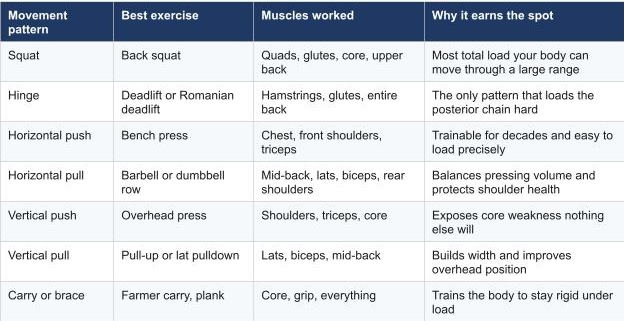
What are the best full body exercises?
Build any full-body workout from these seven movement patterns, and you will not leave gaps.
Who is a full body workout routine best for?
Four groups get the most out of this structure.
People with three days a week. This is the whole point. Three days is enough to make real progress if all three days are full body sessions.
Anyone coming back after time off. Returning after six months away, your limiting factor is not volume. It is skill and connective tissue. Practicing the same movement patterns three times a week rebuilds both faster than seeing each one once.
Beginners. Repetition teaches technique. Squatting once a week means twelve squat sessions in three months. Squatting three times a week means thirty-six.
Parents. This is the practical one. Three sessions is far easier to protect than five, and if childcare is the barrier, our Kids Club is on site at participating locations, so the workout happens while your kids are looked after in the same building.
Who should probably choose something else? Advanced lifters chasing a specific weak point, and anyone training for a sport with high skill demands who needs their sessions organized around practice rather than around movement patterns.
What mistakes do people make with full body workouts?
Training on back-to-back days. The plan needs 48 hours between sessions. Monday and Tuesday full body sessions are the fastest way to feel beaten up and blame the program.
Doing too much per session. Eighteen sets is the ceiling, not the floor. Adding four more exercises because you feel good on Monday means you will not recover for Wednesday.
Going heavy on all three days. The emphasis rotates for a reason. If your squat, deadlift, and press are all at maximum effort every session, something is going to give.
Cutting rest to save time. Covered above, with numbers.
Skipping the warm-up. Ten minutes. Your first heavy set of squats is not a warm-up.
Ignoring what happens outside the gym. Three hard sessions a week place real demand on recovery. Our guides on hydration for lifting and creatine timing cover two of the levers people most often overlook.
How to fit this total body workout into your week
Three lifting days leaves four open. You do not need to fill them, but here is what we would do with them.
Two of those days, add something that raises your heart rate without adding leg fatigue: a walk, a swim, a bike. One of our TRU Classes works well here if you want the structure and the room full of people. If you like intensity, HIIT training fits on a non-lifting day, though we would not stack it the day before a heavy squat session.
The other two days, do nothing on purpose. Rest is where the adaptation happens. If your gym has recovery amenities like a sauna or massage chairs, that is a good use of a rest day, and worth knowing what your location offers.
For members who prefer training without a crowded floor, most of our clubs include a women-only workout area with its own equipment, which makes the whole plan runnable in a quieter space.
Start this week
Print the three tables above, or better, come try the first session with someone watching your form. A TruFit personal trainer will walk you through all five core lifts, set your starting weights, and build the eight-week progression around whatever days you can actually commit to.
Not a member yet? Grab a risk-free 3-day guest pass, run Day 1 on us, and see how the floor feels.
Frequently Asked Questions
Is a full body workout 3 times a week enough to build muscle?
Yes, for most people. Three sessions get each muscle group nine to twelve hard sets per week, which sits inside the productive range for hypertrophy. The 2019 meta-analysis in the Journal of Sports Sciences found no meaningful hypertrophy advantage for higher frequencies once weekly volume was matched.
What is the 3 3 3 rule for working out?
There is no standard 3-3-3 rule in strength training. The phrase circulates online attached to several different meanings, most commonly three exercises, three sets, three times a week. It is a memory device rather than a research-backed protocol. Weekly volume, load progression, and consistency are what actually determine results.
What are the 4 exercises for full body?
If you only had four, pick a squat, a hinge, a horizontal push, and a horizontal pull: back squat, deadlift, bench press, and row. Those four cover every major muscle group. Adding an overhead press and a vertical pull is what turns four exercises into a complete program.
Can you do a full body workout every day?
Not at the intensity in this plan. Muscle needs roughly 48 hours to recover from hard resistance training, and daily heavy sessions accumulate fatigue faster than you adapt to it. If you want to train daily, alternate hard lifting days with easy movement days.
How long should a full body workout take?
Fifty to sixty-five minutes including a warm-up. Sessions that run past ninety minutes usually mean too many exercises or too much time between sets spent on your phone.
Is a full body workout good for weight loss?
It helps, mainly by preserving muscle while you are in a calorie deficit, which keeps your metabolism and your strength where you want them. Nutrition drives fat loss. Training determines how much of what you keep is muscle.