
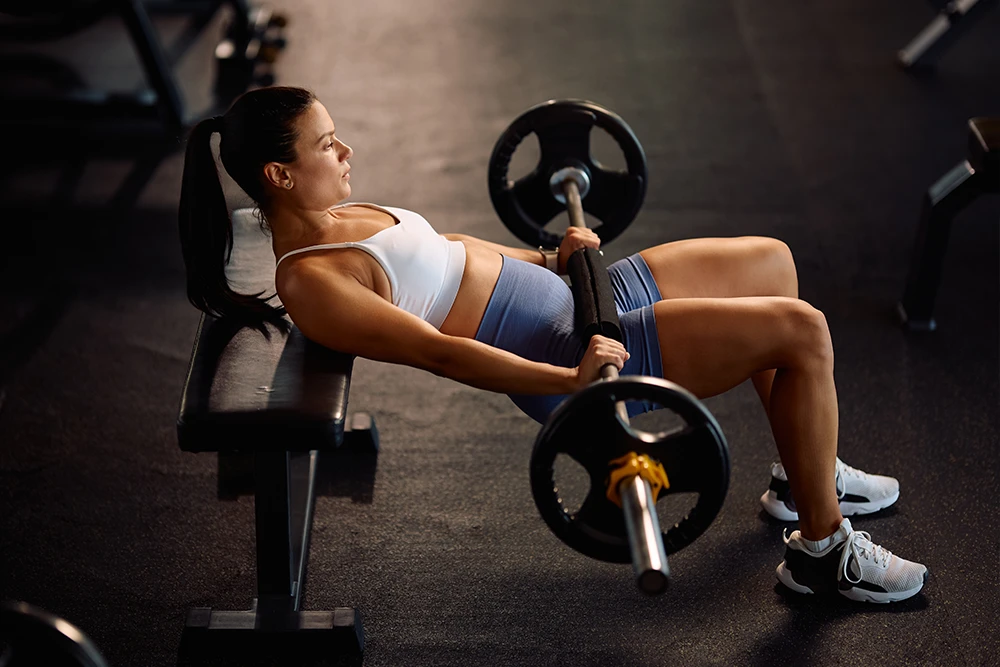
The hip thrust is a barbell exercise that loads hip extension with your upper back on a bench and your feet flat on the floor. It trains the glutes harder than any squat variation, and the whole thing lives or dies on setup: bench at shoulder-blade height, bar over the hip crease, shins vertical at the top.
Most people do not struggle with the hip thrust because they are weak. They struggle because getting into position is genuinely awkward the first time, and because two or three small setup errors add up to a lift where you feel your hamstrings, your low back, and your quads doing everything except the thing you came for.
This guide is the setup. Bench, bar, feet, ribs, and the cue that fixes the most common problem in one rep. Get those right, and the hip thrust exercise stops being awkward and starts being the most productive thing in your lower body session.
What muscles do hip thrusts work?
Primarily the gluteus maximus. Secondarily the hamstrings, adductors, and core, with the quads working modestly. That is the short answer on hip thrust muscles worked, and the long answer is more interesting.
The numbers behind this are unusually clear. Contreras, Cronin, Vigotsky, Schoenfeld and Beardsley put thirteen trained women through both exercises at a 10-rep max load and measured muscle activity, publishing in the Journal of Applied Biomechanics.
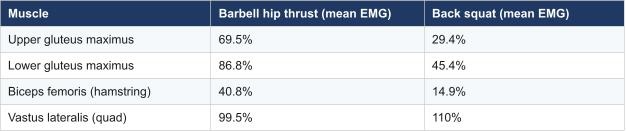
Read the bottom row too. The squat matched or beat the hip thrust for quad activity, which is the honest version of this comparison: these are not competing exercises; they are different tools. The hip thrust roughly doubles glute activation. The squat owns the quads.
Do hip thrusts actually build more glute muscle than squats?
Not necessarily, and this is where most articles stop being useful.
Activation is not growth. A 2023 study in Frontiers in Physiology trained 34 people for nine weeks, twice a week, on either hip thrusts or back squats. Result: gluteus maximus growth was similar between groups across upper, middle and lower regions. Point estimates modestly favoured the hip thrust, but not by enough to call it a winner.
What did differ was everything else. Strength gains were specific to whichever lift each group trained. Hip thrust 3-rep max rose 63 percent in the thrust group against 34 percent in the squat group. Squat 3-rep max rose 44 percent in the squat group against 17 percent in the thrust group. Deadlift improved about the same in both, around 15 to 16 percent. And the squat group also grew their quads and adductors, which the thrust group did not.
So the defensible claim is this. The hip thrust is an outstanding, highly specific glute exercise that lets you load hip extension heavily with very little else in the way. It is not a magic replacement for squatting. Our glute exercises guide covers the full menu and where each movement fits; this page is about executing one of them properly.
How to do a hip thrust: the setup
Everything below assumes a flat bench and a barbell, which is what you will find in the free weight area on the TruFit floor.
Step 1: Set the bench
- Push the bench against a wall or a rack upright so it cannot slide. If nothing is available, put a heavy dumbbell or a plate behind it.
- Sit on the floor with your back against the long edge of the bench.
- The bench should meet you just below your shoulder blades. Not your neck, not mid-back. Just under the blades.
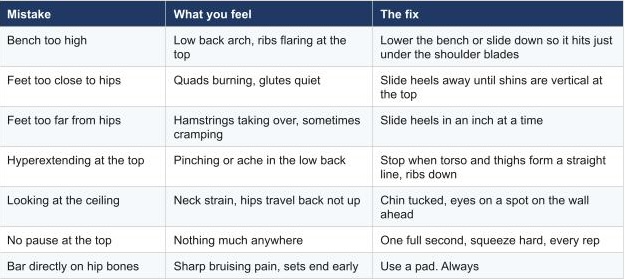
If the bench is too high, your ribs will flare and your low back will arch at the top. If it is too low, you lose range of motion. Most standard benches are close to right for most people, which is why the far more common error is the next one.
Step 2: Get the bar over your hips
- Sit with your legs straight and roll the loaded bar up your thighs until it sits in your hip crease.
- Use a pad. A barbell directly on your hip bones is not a toughness test, it is just a reason to stop the set early.
- Bend your knees and plant your feet.
- Hold the bar with both hands about shoulder width and keep it pinned there for the whole set.
On bar position specifically: the bar should sit in the crease of your hips, not up on your lower abdomen and not down on your upper thighs. Slightly above the hip joint rather than directly on top of it is more comfortable for most people and does not change what your glutes are doing.
Step 3: Set your feet
- Feet flat, about hip width, toes pointed slightly out.
- Heel position is the variable that decides what you feel. If your shins are vertical at the top of the rep, your feet are in the right place.
- Feet too close to your hips and you will feel it in your quads. Feet too far away and your hamstrings take over.
This is the fix for the single most common complaint we hear. When a member says they cannot feel their glutes on hip thrusts, roughly nine times out of ten the answer is moving the feet two or three inches, not adding weight or changing the exercise. Take one set at a light load and slide your heels an inch at a time until the top of the rep feels like the glutes are doing the work.
Step 4: The rep
- Tuck your chin slightly and look at a point on the wall in front of you, not at the ceiling.
- Drive through your heels and push your hips straight up.
- Finish with your torso and thighs in a straight line. Not higher. The instinct to keep going comes from your lower back, not your glutes.
- Ribs down, glutes squeezed hard, pause for one full second at the top.
- Lower under control until your hips are just above the floor, then go again.
That one second pause at the top is the whole exercise for most people. The hip thrust has a short range of motion and no stretch to bounce out of, which makes it very easy to turn into a bouncing motion that trains nothing. Pause, or the set does not count.
Hip thrust mistakes and how to fix them
Glute bridge vs hip thrust: what is the difference?
The glute bridge is done from the floor. The hip thrust is done with your upper back elevated on a bench. That is the entire structural difference, and it changes three things.
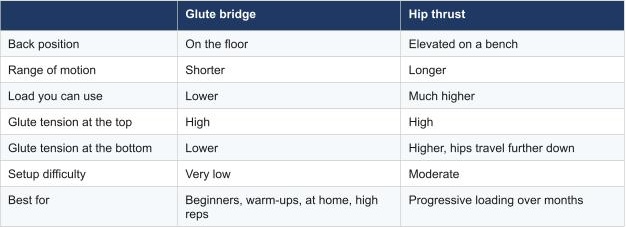
Practical version: start with the glute bridge if the hip thrust setup feels like too much, or if you are training at home. Move to the hip thrust when you want to add weight in a way you can keep adding to. Both belong in a program and neither replaces the other.
You may also see the KAS glute bridge, which uses the hip thrust bench setup but a deliberately shortened range where the shins stay vertical throughout and the hips never drop far. It keeps constant tension on the glutes and takes the quads almost entirely out. It is a good variation once your standard hip thrust is solid, and a confusing place to start.
Hip thrust variations worth knowing
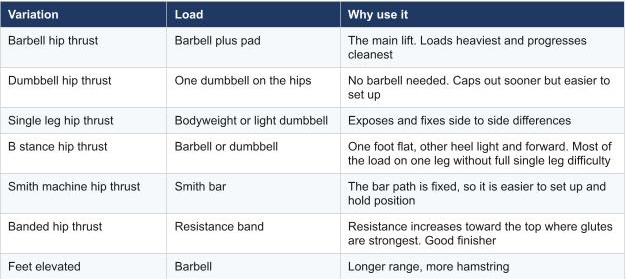
A dedicated hip thrust machine, sometimes called a glute drive, does the same job with a much easier setup, which is a real advantage on a busy floor. Equipment varies by location, so check what your club has.
How many sets and reps should you do?
Three to four sets of six to twelve reps, one or two days a week, is the range that covers most goals.
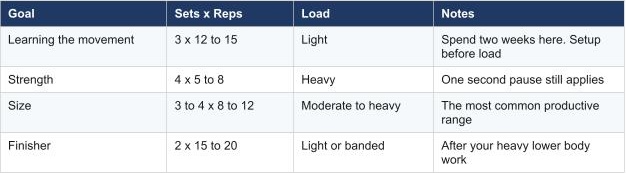
Where it goes in the session matters. If glutes are the priority, hip thrust first, before squats or deadlifts. If you are training for squat or deadlift strength, put the hip thrust after them. Our guides on lower body exercises and choosing a workout split cover how to sequence a full lower body day around it.
Pair the hip thrust with a hinge rather than another bridge. The Romanian deadlift loads your glutes and hamstrings in a lengthened position, which is the part the hip thrust does least, and our hamstring exercises guide has the rest of the posterior chain covered.
Get your setup checked once
The hip thrust is one of the few lifts where a single session with someone watching saves you months. Bench height, bar position, and foot placement are all things you cannot see from underneath the bar, which is why hip thrust form is so much harder to self-correct than a squat you can film from the side.
The benches, barbells, dumbbells and lifting platforms you need are all on the TruFit floor, and a TruFit personal trainer can set your position, find your foot placement, and give you the loading progression in one appointment.
Frequently Asked Questions
What are hip thrusts good for?
Building glute strength and size, and improving hip extension power, which carries over to sprinting and jumping. The 2015 EMG study found the barbell hip thrust roughly doubled gluteus maximus activation compared with the back squat at a matched 10-rep max load.
What is the 8-8-8 rule for hip thrusts?
It is a social media protocol, not an established training standard: eight full reps, eight pulse reps at the top, eight second hold. It is a reasonable finisher and a poor primary method, because none of the three parts is progressively loadable in a way you can track over months. Sets and reps you can add weight to beat it.
What happens if I do hip thrusts every day?
Your glutes need recovery like any other muscle, and daily heavy hip thrusts accumulate fatigue faster than you adapt. One or two sessions a week is enough for most people. Light banded work more often is fine.
Why can’t I feel my glutes during hip thrusts?
Almost always foot position. Slide your heels until your shins are vertical at the top of the rep, then add a hard one second squeeze. If that does not fix it, the bench is probably too high and your low back is taking over.
Hip thrust vs glute bridge, which should I do?
The glute bridge if you are starting out or training at home. The hip thrust once you want to load it heavily and keep progressing. The hip thrust has a longer range of motion and a much higher ceiling for weight.
How much should I be able to hip thrust?
More than you can squat, usually, which surprises people. There is no meaningful standard, and chasing a number here tempts you into the two faults that make the lift useless: bouncing and hyperextending. Add five to ten pounds when you complete every rep with a clean one second pause.
Do hip thrusts make your glutes bigger or just stronger?
Both, when you progressively load them and eat enough. The 2023 trial found similar gluteal growth from hip thrusts and squats over nine weeks, so the exercise is one good option among several rather than the only one that works.