

The best treadmill workout is the one that changes something. Pick a format and follow it: steady-state for aerobic base, intervals for conditioning in less time, incline walking for low-impact effort, or speed work for pace. Twenty to forty minutes is enough for all four.
Most people use a treadmill the same way every time. Climb on, punch in 3.5, walk until the clock runs out. That is not nothing, but it stops producing results the moment your body adapts to it, which takes about three weeks.
The fix is not working harder. It is having a format. Below are four, with exact speeds, inclines, and durations, plus a pace chart so you know what the numbers on the console actually mean.
What is the best treadmill workout?
There is no single best one, and any article that names one is guessing about you.
What the research does support is that both moderate steady work and hard intervals improve your cardiovascular fitness substantially, with intervals holding a modest edge. Milanović, Sporiš and Weston pooled 28 controlled trials covering 723 participants in Sports Medicine. Continuous endurance training raised VO2max by 4.9 mL/kg/min. Interval training raised it by 5.5. Compared head to head, intervals held a small advantage of 1.2 mL/kg/min, and that advantage grew for older participants and for people starting from lower fitness.
Translated: intervals are slightly better per minute, steady work is easier to recover from and easier to sustain, and the gap between them is far smaller than the gap between doing something and doing nothing. Rotate all four formats, and you get the benefits of each without needing to pick a winner.
For weekly volume, the CDC recommends adults get “150 minutes of moderate-intensity physical activity a week,” or “75 minutes of vigorous-intensity or an equivalent combination.” It also notes you can “spread your activity out during the week and break it up into smaller chunks of time.”
Treadmill pace chart: speed to pace conversion
The console shows miles per hour. Every running plan you have ever read is written in minutes per mile. Here is the translation.
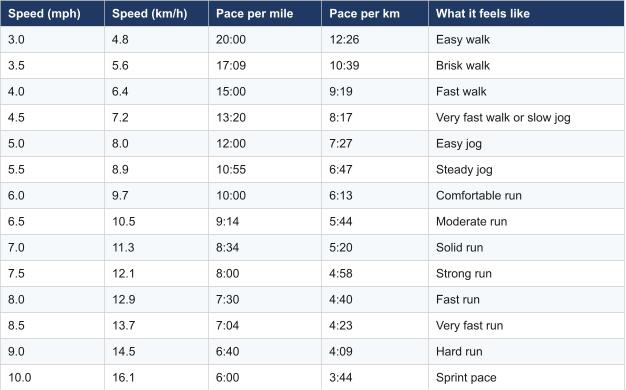
Two things worth knowing. Incline changes the effort without changing the speed, so 3.5 mph at a 10 percent grade is much harder work than 3.5 mph flat, even though the pace column says the same thing. And these are treadmill speeds, not outdoor equivalents, which is covered further down.
How hard should a treadmill workout feel?
Two ways to judge it, and you only need one.
The American Heart Association puts moderate intensity at roughly 50 to 70 percent of maximum heart rate and vigorous at about 70 to 85 percent, with maximum heart rate estimated as 220 minus your age.
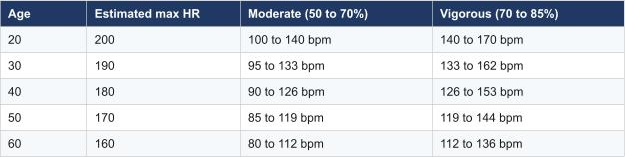
The simpler method needs no watch at all. Can you hold a full conversation? That is easy. Can you speak in short sentences but not paragraphs? That is moderate. Can you get out three or four words? That is hard. This is the cue our coaches use on the floor, because it works on every body regardless of what a formula predicts, and because the 220 minus age estimate can be off by fifteen beats in either direction.
The 4 treadmill workout formats
Each one has a different job. Run one to three of them a week depending on how many days you have.
Format 1: Steady-state treadmill cardio
The job: build the aerobic base that makes everything else easier.

Pick a speed you could hold for an hour if you had to. For most people, that is somewhere between 3.5 and 6.0 mph. The mistake here is going too hard, which turns an easy day into a mediocre hard day and leaves you too tired for your actual hard sessions.
This is the format to pair with lifting. Our guide on cardio before or after weights covers why ten to fifteen minutes of steady work after a lifting session leaves you feeling loose rather than stiff, and why leading with hard cardio costs you on the weights.
Format 2: Treadmill interval workout
The job: the most conditioning per minute of any format here.
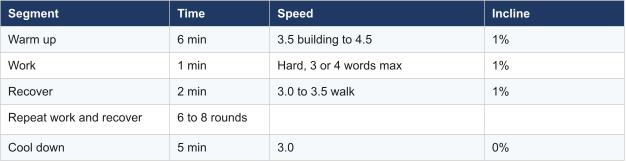
Total time is 29 to 35 minutes. Your hard minute should be genuinely hard by round three. If round eight feels the same as round one, you went too easy.
Two coaching notes. Straddle the belt or step to the side rails during recovery rather than jabbing the speed button down and up, because most treadmills take fifteen seconds to change speed and you will spend half your work interval waiting for the belt. And do not add incline to your first few interval sessions. Speed alone is enough to learn on.
Format 3: Incline treadmill workout
The job: high effort, low impact. This is the one to use if your knees complain about running.
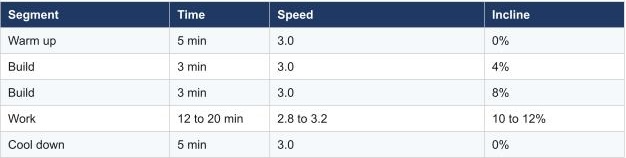
A treadmill incline workout recruits your glutes, hamstrings, and calves harder than flat walking while keeping impact forces low. It is the reason the 12-3-30 workout caught on, and that guide is the place to go if you want to build toward the full twelve percent version specifically.
The single biggest error in this format is holding the handrails. Gripping the rails transfers a large share of your bodyweight into your arms, which means the incline number on the console stops describing what your legs are doing. In our experience at TruFit, when a member drops the incline from 12 to 8 and lets go of the rails, their heart rate goes up, not down. If you cannot let go, the incline is too high. Lower it.
If you want more from the muscles this format loads, our guides on glute exercises and hamstring exercises pair well with incline walking days.
People ask which is better, the StairMaster or an incline treadmill. They train the same muscles through different ranges. The stair climber demands more hip and knee flexion per step and tends to feel harder at the same heart rate, while the incline treadmill is easier to control precisely and easier to hold a conversation on. If you are choosing based on which one you will actually do three times a week, that is the right way to choose.
Format 4: Speed work
The job: make a given pace feel easier. Only worth doing once you have a base.
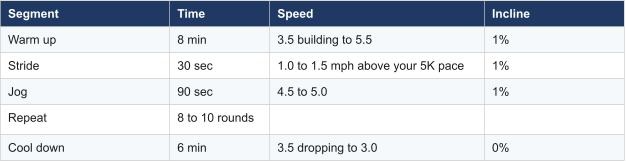
Use the pace chart above to find your target. If your comfortable run is 6.0 mph, your strides go at 7.0 to 7.5.
Skip this format if you have been running less than about six weeks. A treadmill running workout at this intensity is what you add once steady-state and intervals are established, not the thing you start with. Adding it too early is the most common reason new runners pick up shin and knee complaints.
Which treadmill workout should you choose?
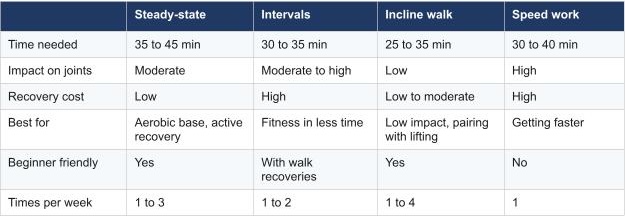
A reasonable week with three treadmill sessions: one interval day, one incline walk, one steady-state. Add speed work only when you have a fourth day and six weeks of consistent running behind you.
If you are lifting as well, the incline walk is the format that interferes least. Slot it on a lifting day or the day after leg day. How this fits your overall week depends on your split, and our guide on choosing the right workout split covers where cardio belongs in each one.
Should you set the treadmill to 1% incline?
Yes, if you are running. The reason is real, and it comes from a specific study.
Jones and Doust tested this directly in the Journal of Sports Sciences. Outdoors, you push against air resistance, and you have to generate your own forward motion. On a treadmill, the belt does part of that for you. Their finding: a 1 percent grade most accurately reflects the energetic cost of outdoor running. At slower speeds, below roughly 7.5 mph, flat and 1 percent were both close enough to outdoor running to be indistinguishable. Above about 8.4 mph, the difference became significant and outdoor running landed between 1 and 2 percent grade.
Practical version: if you are walking, incline is a training variable and zero is fine. If you are running, set 1 percent and leave it. If you are running faster than about 8.5 mph and training for an outdoor race, use 1 to 2 percent.
Treadmill mistakes we see most
Holding the handrails. Covered above, and it is the most common one by a wide margin. Rails are for getting on and off.
Running with the console at eye level. Watching your feet or hunching toward the screen changes your posture for the whole session. Pick a spot on the wall at eye height and look at it.
Using the same speed forever. Your body adapts in about three weeks. If the numbers have not moved in a month, the workout is now maintenance.
Treating the calorie display as fact. Treadmill calorie estimates do not know your weight, your fitness, or your body composition unless you enter them, and they run optimistic even when you do. Use it to compare today against last Tuesday, not as an accounting ledger.
Skipping the cool down. Five minutes of easy walking. Stepping off a treadmill at speed with your heart rate at 160 is how people end up dizzy in the locker room.
Forgetting to drink. Indoor cardio without wind makes you sweat more than you expect. Our guide on hydration covers how much and when.
Pick a format and start this week
Every treadmill on the TruFit floor does all four of these, and you do not have to guess at your starting numbers. A TruFit personal trainer can set your paces from a short test rather than a formula, and build the week around whatever days you actually have.
If you would rather have someone else count the intervals, our group fitness classes and HIIT training cover the same ground with a coach in the room. When you are done, the Relax and Recovery area is there for the part most people skip.
Not a member yet? Take a risk-free pass, run one of the four formats above, and see how it feels.
Frequently Asked Questions
What is the 12-3-30 treadmill workout?
Twelve percent incline, 3 miles per hour, 30 minutes. It is an incline walking workout that went viral on social media, and it works because incline walking produces a high effort at low impact. Our full 12-3-30 guide covers how to build up to it if 12 percent is too steep on day one, which it is for most people
Is walking 30 minutes a day on a treadmill enough?
For the CDC’s baseline guideline, yes. Thirty minutes of brisk walking five days a week meets the 150-minute moderate-intensity target. Whether it is enough for a specific body composition goal depends on your food intake far more than on the walk.
Is a treadmill good for losing belly fat?
A treadmill workout helps create the calorie deficit that reduces body fat overall, but you cannot direct where that fat comes off. Spot reduction is not a thing. Combining treadmill work with strength training preserves muscle while you lose fat, which is what makes the result look like what people are actually after.
How long should a treadmill workout be?
Twenty to forty-five minutes, including warm-up and cool-down. Intervals sit at the short end, steady-state at the long end. Sessions past an hour rarely add much for general fitness.
Is a treadmill workout as good as running outside?
Close, with one adjustment. Set 1 percent incline to account for the missing air resistance, per the Jones and Doust finding above. Treadmills are gentler on your joints and let you control pace precisely. Outdoor running trains terrain changes and stabilizing muscles that a flat belt does not.
Can you do a treadmill workout every day?
Daily walking, yes. Daily hard running or intervals, no. Alternate hard sessions with easy ones, or with rest, so the hard days stay hard.
How do I make treadmill workouts less boring?
Give yourself something to execute. The reason all four formats above have a table is that following a plan for thirty minutes is a different experience from waiting out thirty minutes. Intervals in particular pass quickly because you are only ever counting to one minute.